Claim tax relief for VDU glasses?
As we age, a "normal" pair of glasses with distance and near vision sections becomes unsuitable for computer work, as the intermediate distance to the screen is not adequately covered. There are special work glasses with two different dioptres, where the upper part considers the distance to the screen and the lower part the distance to the keyboard. As these glasses do not include a distance vision section, they are not suitable as everyday glasses. The question is whether the costs of computer glasses can be deducted as work-related expenses.
- Unfortunately, no. The Federal Fiscal Court has ruled that computer work glasses are not work equipment, but a medical aid. Since the glasses are used to correct visual impairment and thus remedy a physical defect, the costs are considered part of private life and are therefore not tax-deductible. This applies even if the remedy of the defect is also in the professional interest. The costs cannot be deducted as work-related expenses even if the glasses are worn exclusively at the workplace. It also does not matter that the glasses are "not suitable as ordinary corrective glasses" according to a medical certificate (BFH ruling of 20.07.2005, VI R 50/03).
- The costs for computer work glasses can be deducted as work-related expenses if the visual impairment is due to a typical occupational disease or a work accident. Otherwise, the costs for the glasses can always be deducted as extraordinary expenses according to § 33 EStG - however, taking into account the reasonable burden.
However, for employees who regularly work at a PC and need special computer work glasses, the employer must cover the costs due to occupational health and safety regulations. This is stipulated in § 6 of the Screen Work Regulation and § 3 para. 3 of the Occupational Health and Safety Act. For the employer, the costs are deductible as business expenses, and for the employee, there is no taxable benefit in kind (R 19.3 para. 2 no. 2 LStR).
Lohnsteuer kompakt
If the costs are covered by the employer, the tax authorities have set a hurdle: The deduction of business expenses by the employer and the tax exemption for the employee will only be granted if the necessity of the visual aid is certified by an ophthalmologist and this medical prescription is issued before the purchase of the glasses.
Reason: Only an ophthalmologist is considered a "qualified person" according to § 6 para. 1 of the Screen Work Regulation, not an optician. This means that the employer is not legally obliged to cover the costs for special visual aids if only an optician certifies the necessity (SenFin. Berlin of 28.09.2009, III B-S 2332-10/2008).
(2021): Claim tax relief for VDU glasses?
Which costs can I deduct?
When purchasing new work-related items, you can deduct not only the pure purchase costs but also the following expenses:
- VAT,
- postage and packaging costs, and
- travel expenses (trips to purchase and to gather information before purchasing).
Immediate deduction: If the purchase costs do not exceed the limit of 800 Euro (excluding VAT) or 952 Euro (including 19% VAT), you can deduct your expenses in full as business expenses in the year of purchase.
Depreciation for wear and tear (AfA): If the purchase costs exceed 800 Euro (excluding VAT) or 952 Euro (including 19% VAT), you must spread the costs over the expected useful life. You can then only claim the annual depreciation (AfA) as business expenses. Please note that you must specify the depreciation to the exact month in the year of purchase. The delivery date is decisive.
Examples of periods over which a work-related item is depreciated:
- Office furniture: 13 years
- Computer, printer, monitor, scanner: 3 years
- Typewriter: 9 years
- Telephone system: 8 years
- Fax machines: 6 years
- Car: 6 years
- Shredder: 8 years
The depreciation period is specified in the so-called AfA tables of the Federal Ministry of Finance.
If you purchase several devices, the 800 Euro limit applies to each device individually if it can be used independently.
Tip
If you cannot provide proof for the purchase of certain work-related items, you can hope for the non-objection limit of 110 Euro. Up to this amount, the tax office generally waives the requirement to present receipts. In this case, however, you should still specify the work-related items with the purchase prices. However, you have no legal entitlement to this!
Incidentally, you can not only deduct work-related items that you have purchased new from tax. You can also claim the purchase of used items as business expenses. However, you must also provide proof of purchase here, especially if you bought the item from a private individual, a receipt is sufficient as proof. The 800 Euro limit also applies to the purchase of used items.
You can also deduct items that have been given to you as a gift or inherited if you use them for work purposes. From this point on, you can deduct the amount that the donor or testator could have deducted if they had used the item for work purposes. The decisive factor is the residual value of the item at the time of work-related use.
Lohnsteuer kompakt
Current: Since 01.01.2021, there has been a particularly advantageous new regulation for all types of computers and software: The Federal Ministry of Finance has very generously stipulated that the normal useful life is generally one year.
This means: The purchase costs of computers and software can now always be deducted in full as business expenses or operating costs in the year of purchase, regardless of the amount (BMF letter dated 26.02.2021, IV C 3-S 2190/21/10002:013).
(2021): Which costs can I deduct?
Is there a standard allowance for additional work-related items?
Many tax offices accept an allowance for additional work-related items. This allowance is a tolerance limit, meaning the expenses do not need to be proven with individual receipts. However, there is no legal entitlement to an allowance for work-related items. The tax officer can always remove expenses for work-related items without proof.
Most tax offices do not require receipts if you claim work-related items as business expenses up to an amount of 110 Euro. However, you have no legal entitlement to this "allowance".
(2021): Is there a standard allowance for additional work-related items?
How can I depreciate work-related items?
Wenn Sie für ein Arbeitsmittel mehr als 800 Euro (ohne Mehrwertsteuer) oder 952 Euro (inkl. 19 Prozent MwSt.) ausgeben, müssen Sie die Kosten über die voraussichtliche Nutzungsdauer verteilen, d.h. abschreiben. In jedem Jahr können Sie dann nur die jeweilige Absetzung für Abnutzung (AfA) als Werbungskosten geltend machen. Arbeitnehmer nutzen hierfür die lineare Abschreibung. Die Dauer der Abschreibung wird in den sogenannten AfA-Tabellen des Bundesfinanzministeriums festgelegt.
Abschreibungsdauer verschiedener Arbeitsmittel:
- Mobile phones: 5 years
- Computers, notebooks and peripherals: 3 years
- Photo, film, video and audio equipment: 7 years
- Typewriters: 9 years
- Office furniture: 13 years
- Safes: 23 years
- Cars: 6 years
For the year in which you purchased the work equipment, the calculated AfA amount can only be deducted on a monthly basis. One twelfth for each month.
Notebook abschreiben
You purchased a notebook for professional reasons on 01.08.2021 for 1.500 Euro. The usage period was set by the tax authorities at three years. This results in the following linear annual depreciation: 1.500 Euro divided over 3 years results in an annual depreciation of 500 Euro. Since the purchase was made during the year, the notebook must be depreciated on a monthly basis in the first year:
Depreciation in the year 2021: 500 Euro x 5/12 = 209 Euro (for the months August to December).
Depreciation in the 2nd and 3rd year: 500 Euro each.
Depreciation in the 4th year: 291 Euro (= residual value from the year 2021).
Lohnsteuer kompakt
Current: Since 01.01.2021, there has been a particularly advantageous new regulation for all types of computers and software: The Federal Ministry of Finance has very generously stipulated that the normal service life is generally one year. This means: The purchase costs of computers and software can now always be fully deducted as business expenses or operating costs in the year of purchase, regardless of the amount (BMF letter dated 26.02.2021, IV C 3-S 2190/21/10002:013).
Furthermore: Since expensive computers previously had to be depreciated over 36 months, a favourable regulation applies to devices purchased in previous years 2019 and 2020: The residual value as of 01.01.2021 may now be fully deducted for tax purposes in 2021. If you wish, you can continue to depreciate devices and software purchased before 2021 over three years.
(2021): How can I depreciate work-related items?
How can I claim work clothing as work-related items?
You can deduct expenses for work clothing from your taxes. However, you must note that not all clothing worn during work is considered work clothing. If the clothing can also be worn outside of work, it is not considered work clothing for tax purposes. If private use of the clothing is possible (as with everyday clothing), you cannot deduct the expenses as work-related expenses.
Work clothing must be typical work clothing that is designed and required for professional use due to its nature and characteristics.
For example, the following work clothing is recognised:
- Protective clothing of any kind (e.g. work coats, lab coats, safety shoes),
- black tailcoat for an orchestra musician,
- black skirt for waitresses,
- black suit for undertakers,
- uniforms and service clothing with service badges,
- official attire (judges, prosecutors, lawyers, clergy)
- sportswear for sports teachers
- colour-coded suits and costumes for airline employees,
- white work clothing for doctors, pilots, butcher shop employees.
- white outerwear for hairdressers,
You can deduct the actual proven purchase costs for tax purposes. If the conditions for the deductibility of work clothing are met, you can also claim cleaning costs.
The Berlin-Brandenburg Tax Court recently did not recognise a black suit for a funeral speaker as work clothing. A black suit that does not differ in any way from what a large part of the population wears as formal clothing for special occasions is not typical work clothing. The clothing can be used at any time for private formal occasions. This applies to all professions, including certain professional groups such as funeral speakers, undertakers, Catholic clergy, and head waiters (FG Berlin-Brandenburg, 29.08.2018, 3 K 3278/15, Revision VIII R 33/18). According to the judges, a black suit, black blouses, and black jumpers are not typical work clothing. Whether and to what extent the clothing is actually used by the taxpayer for private occasions is irrelevant. Every undertaker - and every funeral speaker - can use their black suit privately, regardless of whether they work full-time or part-time and how many hours they work professionally. However, the Tax Court's decision contradicts previous BFH rulings. Therefore, the BFH will finally clarify the issue in the appeal (Revision: VIII R 33/18). Until then, it is advisable to keep tax assessments open by means of an objection.
If you wash your work clothing yourself, you can estimate the costs. For the cleaning of work clothing, the tax authorities and the courts recognise the use of consumer association experience values (Baden-Württemberg Tax Court ruling, 3 K 202/04). The Consumer Associations Working Group, Bonn, has determined the costs for a wash cycle, based on one kg of laundry (as of Dec 2002):
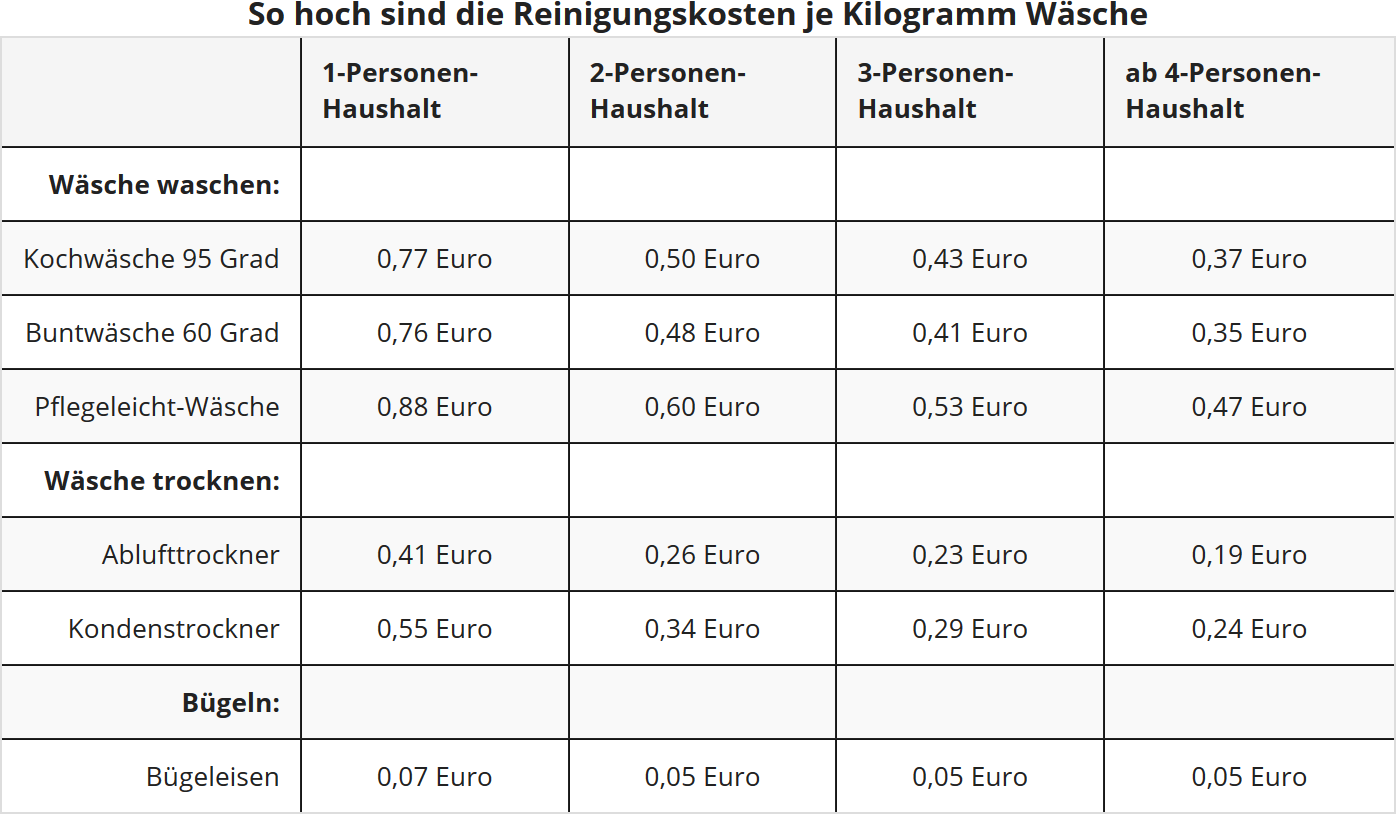
To calculate the proportional annual costs for the care of "typical work clothing" from the table, multiply the above amounts (Euro/kg) in the respective treatment type by the annual amount (kg) of typical work clothing to be cleaned. Example: As a single person, with 40 wash cycles per year at 3 kg of boil wash at 0.77 Euro and 2 kg of easy-care wash at 0.88 Euro, you come to a total of 163 Euro deductible cleaning costs (92.40 Euro plus 70.40 Euro).
Important: The average calculation includes the purchase price of the washing machine, a maintenance allowance, and operating costs such as electricity, water, and detergent. According to the BFH, an annual flat rate for cleaning costs is not permitted.
(2021): How can I claim work clothing as work-related items?
How can I claim a computer as a tax deduction?
If you use your home computer for both private and professional purposes, you can claim the associated costs as income-related expenses on a pro-rata basis for tax purposes. The ten per cent rule, which states that an item is only recognised as a work-related item if it is used at least 90 per cent for work, does not apply to computers. The amount you can deduct for the computer depends on the actual usage time for professional and private purposes.
Beispiel
You use your computer for six hours a week for work and four hours for private purposes. Then 60 per cent of the expenses for your computer and peripherals are deductible.
If you can credibly demonstrate that the computer is used almost exclusively for work (at least 90 per cent), you can even claim the full costs. If proof is difficult or impossible, the proportion of professional use is estimated at 50 per cent, i.e. you can deduct half of the costs. A computer is used privately if you use it for private correspondence, online banking, or gaming. Examples of professional use of a computer include completing work tasks at home (including research tasks), acquiring necessary basic IT knowledge, training, or writing job applications.
When making an initial purchase, you must combine all computer components required for the operation of the PC and depreciate them together over the period of use if the purchase costs exceed the limit of 800 Euro (excluding VAT) or 952 Euro (including 19 per cent VAT). Computer, monitor, keyboard, and mouse constitute a single, independently usable asset "computer". The depreciation period for computers, notebooks, and peripherals is three years. An exception is made for devices that can also be used independently, such as all-in-one devices that are simultaneously printers, fax machines, copiers, and scanners. If the purchase price is below the 800 Euro limit, you can deduct the entire cost immediately.
Professional application programs and system software with purchase costs of up to 800 Euro (excluding VAT) can be fully deducted immediately as income-related expenses. If a program is more expensive, you must spread the purchase costs over the years of expected use, i.e. "depreciate" them. The usage and depreciation period is three years. When purchasing professional software, note that it can be deducted as income-related expenses even if the computer is not recognised. If you purchase additional computer components at a later date, you must add the costs to the remaining value of the PC and spread the sum over the remaining useful life. If your computer has already been depreciated, you should fully deduct the costs if the purchase price does not exceed 800 Euro net. Otherwise, you can also depreciate the devices or software separately. If you replace existing components with new ones, you can deduct the purchase costs as maintenance expenses in full and regardless of the purchase price in the year of purchase.
Tipp
In addition to computers, software, and peripherals, expenses for computer accessories such as printer paper, toner cartridges, printer cartridges, CD/DVD blanks, USB sticks, cables, or batteries are also deductible.
The depreciation period is specified in the so-called AfA tables of the Federal Ministry of Finance.
Lohnsteuer kompakt
Current: Since 01.01.2021, there has been a particularly advantageous new regulation for all types of computers and software: The Federal Ministry of Finance has very generously stipulated that the normal service life is generally one year. This means that the purchase costs of computers and software can now always be fully deducted as income-related expenses or business expenses in the year of purchase, regardless of the amount (BMF letter dated 26.02.2021, IV C 3-S 2190/21/10002:013).
Furthermore, as expensive computers previously had to be depreciated over 36 months, there is a favourable regulation for devices purchased in previous years 2019 and 2020: The remaining value as of 01.01.2021 may now be fully deducted for tax purposes in 2021. If you wish, you can continue to depreciate devices and software purchased before 2021 over three years.
(2021): How can I claim a computer as a tax deduction?
When can I claim professional literature?
If you use professional literature for your work, you can deduct the expenses for books, magazines, and newspapers. Professional books with a clear title indicating their professional use are readily accepted.
For general educational books, proving professional use is more difficult. However, you should know that a rejection by the tax office on the grounds that it is not a professional book is not sufficient. The actual use of the book is what matters. You must prove to the tax officer that you use the book professionally. You can also deduct magazines as professional literature if they are professional journals providing work-related information.
The deductibility of magazines is complicated by the fact that many magazines cover a wide range of topics and do not exclusively provide work-related information. In such cases, the magazines will not be recognised. A similar issue arises with the deductibility of newspapers.
Typical daily newspapers cannot be deducted due to their broad range of topics. However, non-typical daily newspapers, such as the Handelsblatt, can be deducted if you can prove predominantly professional use. Of course, you must also provide evidence of the expenses for professional literature. If you have not collected the relevant receipts, you can enter an amount of 110 Euro without proof.
However, this is not an allowance to which you are legally entitled, but merely a limit of tolerance. Up to this amount, tax officers are supposed to waive receipts. The limit of tolerance applies to work-related items in general. So, if you have already used the 110 Euro for work clothing, proof of expenses for professional literature is still required.
(2021): When can I claim professional literature?
What work-related items can I deduct?
As work-related items, you can deduct objects from tax that you use almost exclusively for professional purposes or, if you are self-employed, for business purposes. You can claim the costs as income-related expenses or business expenses. Not all work-related items are always recognised by the tax office. The more specialised a work-related item is, the higher the chance it will be recognised.
Whether you can deduct it from tax depends on your profession and the work-related item. The condition that you use a work-related item almost exclusively for professional purposes is met if it is used for at least 90 per cent for professional purposes. In this case, you may deduct the work-related item in full as income-related expenses.
Until 2009, the all-or-nothing principle generally applied: either the costs were fully recognised or not at all. It was not permissible to allocate costs according to their use for professional purposes - e.g. 70 per cent. However, the Federal Fiscal Court overturned the prohibition on allocation and deduction under section 12 no. 1 EStG in September 2009. After closer examination, the Grand Senate of the Federal Fiscal Court came to the conclusion that it had been mistaken for around 30 years and that the prohibition on allocation and deduction could not be derived from the law (section 12 no. 1 EStG).
This means that today it is possible in many cases to allocate costs that were previously refused for exactly this - incorrect - reason. Costs can be allocated according to objective criteria if the professional usage shares are fixed and not of minor importance (Federal Fiscal Court ruling of 21.09.2009, GrS 1/06, BStBl. 2010 II p. 672).
The following items (examples) can be deducted as income-related expenses depending on the occupational group:
- Typical work clothing
- Computer and software
- Specialist literature
- Desk and office chair
- Filing cabinet
- Briefcase
- Photocopier
- Calculator
- Tools
- Telephone, fax, mobile phone costs
- Office supplies (stationery, pens, paper, files, etc.)
If you pay no more than 800 Euro (net) or 952 Euro (incl. 19 per cent VAT) for a work-related item, you can deduct the entire cost in the year of payment as income-related expenses. However, the work-related item must be independently usable. This is not the case, for example, with a monitor, printer or scanner. These can only be used together with a computer. If you spend more on a work-related item, you must spread the costs over the expected useful life.
Lohnsteuer kompakt
Current: Since 01.01.2021, there has been a particularly advantageous new regulation for all types of computers and software: The Federal Ministry of Finance has very generously stipulated that the normal service life is generally one year. This means: The purchase costs of computers and software can now always be deducted in full as income-related expenses or business expenses in the year of purchase, regardless of the amount (BMF letter of 26.02.2021, IV C 3-S 2190/21/10002:013).
Furthermore: As expensive computers previously had to be depreciated over 36 months, there is an advantageous regulation for devices purchased in previous years 2019 and 2020: The remaining value as of 01.01.2021 may now be fully deducted for tax purposes in 2021. If you wish, you can also continue to depreciate devices and software purchased before 2021 over three years.
(2021): What work-related items can I deduct?
Can I claim wear and tear on "normal" clothing for tax purposes?
Expenses for "normal" clothing are not deductible as income-related expenses if this clothing is subject to normal dirt and wear during work.
However, if the dirt, damage, or premature wear is due to a specific professional or business incident, the costs for cleaning, repair, or replacement are deductible as income-related expenses (BFH ruling of 24.7.1981, BStBl. 1981 II p. 781; FG Thuringia of 4.11.1999, EFG 2000 p. 211).
When replacing an item of clothing, the residual value of the damaged item is deductible.
(2021): Can I claim wear and tear on "normal" clothing for tax purposes?
What is the non-assessment limit?
Many tax officials may deny their existence. And taxpayers cannot rely on benefiting from them, as there is no legal entitlement to the non-consideration limits.
Non-consideration limits are amounts – usually small – in the tax return that tax officials generally do not scrutinise closely and accept without proof.
Here are some examples:
- Working days for travel allowance: For a 5-day week, you can state 230 working days per year and for a 6-day week, 280 days.
- Work-related items: You can usually claim costs up to 110 Euro for the purchase and maintenance of work-related items (purchase and cleaning of work clothing) in your tax return without receipts.
Note
Journeys to work, specifically to the primary workplace, are deductible with the commuter allowance. In principle, every employee is required to state the exact number of days they actually travelled to work in their tax return (Form N), as the allowance is only granted for these days. To check whether the number of declared working days is plausible, holiday and sick days must also be declared. Since 2020, business travel days and home working days have also been queried in Form N.
However, it can be very tedious to determine the exact number of working days. Who keeps a daily tally? And then there are employees who also visit the workplace at weekends, sometimes unexpectedly. Therefore, the tax offices established so-called non-consideration limits decades ago. They generally accepted 220 to 230 journeys for a five-day week and 260 to 280 journeys for a six-day week between home and workplace. It should be noted that these are internal limits of the tax offices, and there is no legal entitlement to their application, even though the Munich Tax Court ruled a few years ago that the tax offices should accept 230 days (FG Munich, 12.12.2008, 13 K 4371/07).
So far, so good. But COVID-19 has changed everything. Countless employees were and still are working from home and do not travel to the office or workplace daily. For these days, they can claim a flat rate of 5 Euro per day as work-related expenses (applies to tax returns for 2020 and 2021) or even the costs for a home office. However, due to the lack of journeys, they may not claim travel expenses.
And this is precisely where the tax offices are increasingly intervening, requiring an employer's certificate of the actual working days and, above all, the days on which the primary workplace was visited. The rule that 220 or 230 journeys per year are accepted no longer applies without exception for the years 2020 and 2021!
(2021): What is the non-assessment limit?
Sichern Sie sich einfach die volle Steuererstattung, die Ihnen zusteht!
Nur Lohnsteuer kompakt bietet Ihnen:
- Persönliche Steuertipps im Wert von 312 Euro (Durchschnitt)
- Verständliche Eingabehilfen und Erklärungen
- Import aus jeder beliebigen anderen Steuersoftware
- Schnelle Antworten bei Fragen
Jetzt kostenlos testen