New overnight allowance for professional drivers
In 2020, a new overnight stay allowance was introduced. Until now, long-distance lorry drivers who sleep in the cab of their lorry have not been able to claim overnight stay allowances. However, they incur expenses for using sanitary facilities at service stations (shower, toilet) and for cleaning the sleeping area in the lorry (bedding).
Such expenses can already be deducted by long-distance lorry drivers as incidental travel expenses in an estimated amount for tax purposes or reimbursed tax-free by the employer (BMF letter dated 4.12.2012, BStBl. 2012 I p. 1249; BFH ruling dated 28.3.2012, VI R 48/11).
From 1.1.2020, a new travel allowance for long-distance lorry drivers was introduced, which can be claimed instead of the actual costs. The overnight stay allowance of 8 Euro per calendar day can be claimed as business expenses in addition to the "normal" meal allowance. The new overnight stay allowance applies to
- the day of arrival or departure, and
- each calendar day with an absence of 24 hours as part of an external activity in Germany or abroad (§ 9 para. 1 sentence 3 no. 5b EStG, inserted by the "Act on the Further Tax Promotion of Electromobility and the Amendment of Other Tax Regulations"). The overnight stay allowance of 8 Euro is taken into account for each calendar day on which the employee could claim a meal allowance for external activity.
- This allowance is applied instead of the actual additional expenses. If the new allowance is claimed, the amount of the actual expenses is irrelevant. Only actual expenses must have been incurred in principle.
- Higher expenses than the 8 Euro can also be proven and claimed (e.g. on the basis of the BMF letter dated 4.12.2012, BStBl. 2012 I p. 1249). The decision to claim the actual additional expenses or the statutory allowance can only be made uniformly in the calendar year.
- Additional expenses are usually expenses that are included in the overnight costs deductible as business expenses for other employees with overnight stays during a business trip. Expenses may therefore include:
- Fees for using sanitary facilities (toilets, shower or washing facilities) at service stations and truck stops,
- Parking or storage fees at service stations and truck stops,
- Expenses for cleaning the own sleeping area.
- The employer can provide reimbursements uniformly in the calendar year either up to the amount of the proven actual additional expenses or up to the amount of the new allowance tax-free.
- The new overnight stay allowance applies not only to employees but also to self-employed long-distance lorry drivers (§ 4 para. 10 EStG).
Tip: If you want to claim an amount higher than the overnight stay allowance, the following procedure is recommended: Record all expenses for a representative period of 3 months. You can then determine the daily cost amount from this and use it as a basis in the future, as long as the circumstances do not change significantly. Expenses do not include vouchers that you use to offset purchases (BMF letter dated 4.12.2012).
Meal allowances increased from 2020
Current meal allowances will be increased from 1.1.2020, by 4 Euro or 2 Euro in Germany (§ 9 para. 4a sentence 3 EStG, amended by the "Act on the Further Tax Promotion of Electromobility and the Amendment of Other Tax Regulations").
(2021): New overnight allowance for professional drivers
New 2021 meal and accommodation allowances
For business-related trips abroad and double housekeeping abroad, the following meal and overnight allowances apply in 2021 (BMF letter dated 03.12.2020, IV C 5-S 2353/19/10010-002).
For employment at an external location or double housekeeping abroad, the following applies:
- The country-specific meal allowances can be claimed by the employee as business expenses or reimbursed tax-free by the employer. It is not possible to claim the actual costs as business expenses.
- The country-specific overnight allowances can no longer be claimed as business expenses since 2008, although the employer may reimburse them tax-free. Only the actual and proven overnight costs are deductible.
For one-day trips abroad, the relevant allowance for the last place of work abroad applies. For multi-day trips in different countries, the following applies to determine the meal allowances on the days of arrival and departure as well as on intermediate days (days with 24 hours absence):
- For travel from Germany abroad or from abroad to Germany without work, the relevant allowance for the place reached before 24:00 local time applies.
- For departure from abroad to Germany or from Germany abroad, the relevant allowance for the last place of work applies.
- For intermediate days, the relevant allowance for the place reached by the employee before 24:00 local time usually applies.
- If a further one- or multi-day external activity follows the day of return from a multi-day external activity to the home or first place of work, only the higher meal allowance is to be considered for this day.

(2021): New 2021 meal and accommodation allowances
What can I deduct as additional travel expenses?
In addition to travel expenses, accommodation and meal allowances, you can also deduct other costs incurred in connection with your off-site work. These include, among others:
- Parking fees, tolls, garage rental
- Telephone charges for business calls
- Entrance fees for business events
- Luggage storage fees
- Costs for currency exchange and loss on repurchase
- Compensation for traffic accidents
- Damage to travel luggage
- Theft of items (professionally used items, private items taken for business purposes, necessary personal travel items)
Loss of money or jewellery is not reimbursed.
For many incidental travel expenses, there are no receipts. You can still claim these in your tax return. Create a self-issued receipt with the location, date, type and amount of the expense and submit it.
Tip
If you do not know the exact amount of an item, estimate it. Many tax offices accept an estimated amount if it is plausible.
(2021): What can I deduct as additional travel expenses?
What can I deduct for off-site work?
Expenses related to business trips can be deducted as income-related expenses. These include:
- Travel costs,
- Meal allowances,
- Accommodation costs,
- Incidental travel expenses.
Unlike travel, accommodation, and incidental travel expenses, meal allowances for long-term business trips are always only considered for the first three months of the same business trip.
(1) Travel costs: Journeys can be deducted at actual costs or, if using your own car, at the business travel allowance rate (30 cents per km travelled).
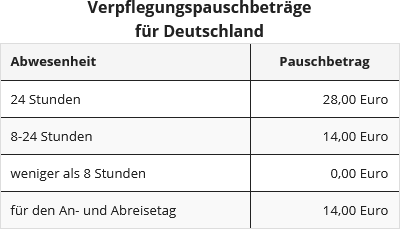
(2) Meal allowances: These amount to 14 Euro for an absence of between 8 and 24 hours and 28 Euro for an absence of 24 hours. The decisive factor is the duration of absence from the home and the first place of work - from the main home, not the home at the place of work. Travel times are included.
(3) Accommodation costs: Only actual and proven costs are deductible. Since 2014, these costs have been recognised in full for the first 48 months, thereafter only up to a maximum of 1.000 Euro per month. This limit applies only in Germany, not abroad.
(4) Incidental travel expenses: Various smaller and larger incidental costs incurred in connection with a business trip are also deductible. These may include travel costs at the destination, e.g. for taxis or rental cars, motorway tolls or ferry costs, parking fees, tips, expenses for telephone calls and business correspondence with the employer or business partners.
A new travel allowance for professional drivers was introduced on 01.01.2020: They can claim an overnight allowance of 8 Euro per calendar day as income-related expenses - in addition to the "normal" meal allowance. This applies to the day of arrival or departure and each calendar day with an absence of 24 hours during a business trip in Germany or abroad (§ 9 Abs. 1 Satz 3 Nr. 5b EStG, introduced by the "Act on Further Tax Promotion of Electric Mobility and Amendment of Other Tax Regulations").
(2021): What can I deduct for off-site work?
When is off-site work applicable?
A business trip occurs when you work temporarily outside your home and your "primary workplace" for business purposes.
A business trip is "temporary" if you are expected to return to your primary workplace and continue your work there.
- An employee can have only one "primary workplace" per employment relationship. Any work outside the primary workplace is considered a business trip.
- In certain cases, the employee may not have a primary workplace at all. In this case, the entire professional activity is considered a business trip. This applies to professional drivers, taxi drivers, train drivers and train attendants, pilots and flight attendants.
- If you are employed on a vehicle: Each new journey constitutes a new business trip.
- If you interrupt long-term work assignments: If the interruption lasts at least four weeks, a new business trip begins. This is important for the deduction of meal allowances, which are only considered for the first three months. Since 2014, the reason for the interruption no longer matters, so holidays or illness also lead to a new start. Until 2013, an interruption due to illness or holiday had no impact on the three-month period.
(2021): When is off-site work applicable?
What should I know about the new 48-month limit?
For off-site work, travel, accommodation, and incidental travel expenses, as well as meal allowances, can be deducted as business expenses.
Since 2014, a new 48-month limit has played a significant role.
(1) The 48-month limit in determining the first place of work
"First place of work" is a fixed business location of the employer to which the employee is permanently assigned. Even without an explicit determination by the employer, a permanent assignment is assumed if the employee is to work at a location for an extended period. This is the case for employment
- indefinitely ("until further notice"),
- for the entire duration of the employment contract (fixed-term or indefinite) or
- for a period of more than 48 months.
TIP: This means: All assignments (transfers, secondments, postings) that are initially limited to a maximum of 48 months do not establish a "first place of work" but rather off-site work. Therefore, travel costs can be deducted with the business travel allowance or with the actual costs, as well as meal allowances and accommodation costs as business expenses or reimbursed tax-free by the employer.
(2) The 48-month limit for work at a customer's premises
Unlike in the past, an employee can now have their "first place of work" at a customer's premises of their employer, but only for long-term work. This applies, for example, to employees who work on a long-term project at the customer's site or temporary workers who work for the hirer without a time limit.
Such long-term work exists if the employee works at a customer's premises or a related company
- from the outset for more than 48 months or
- for the duration of the employment contract.
(3) The 48-month limit for accommodation costs
For overnight stays during off-site work, only the actual costs can be deducted as business expenses. Since 2014, accommodation costs can only be deducted in full or reimbursed tax-free by the employer for a period of 48 months.
From the 49th month, the deduction of business expenses or tax-free reimbursement is limited to comparable expenses for double housekeeping, i.e. to a maximum of 1.000 Euro per month. This limit only applies to off-site work in Germany, not abroad.
Tipp
The 48-month period starts anew if the work at the same place of work is interrupted for at least 6 months. The reason for the interruption (e.g. illness, holiday, work at another place of work) does not matter.
Currently, the Münster Finance Court has confirmed the tax authorities' view and ruled that repeatedly limited assignments to a construction site of less than 48 months each do not establish a "first place of work" there, even if the assignment lasts continuously for more than four years (Münster Finance Court, 25.03.2019, 1 K 447/16).
Special case for temporary workers:
Temporary workers are not employed by the company where they are deployed but by "their" temporary employment agency, often referred to as the "lender". If these employees are "lent" to a specific company for a certain period, the question arises whether they can deduct their travel to the place of work according to travel cost principles (30 cents per kilometre travelled) or only with the lower commuting allowance (30 cents per kilometre).
In principle, travel costs can only be claimed with the commuting allowance if the temporary worker is permanently assigned to a place of work. This is the case if they are to work there for an extended period, namely
- indefinitely ("until further notice"),
- for the duration of the employment contract or
- for a period of more than 48 months.
This means: Temporary workers can also have their "first place of work" at the customer's site if they work there for an extended period. However, this is only the case if the employee is to work there from the outset (!) for more than 48 months or for the duration of the employment contract or indefinitely. Travel is then only deductible with the commuting allowance, meal allowances and incidental travel expenses are not taken into account. Temporary workers who work at customers' premises for a shorter period, on the other hand, are engaged in off-site work and can therefore claim their travel with the business travel allowance - and to a certain extent also meal allowances.
Currently, the Lower Saxony Finance Court has ruled that an employee in a permanent employment relationship with a temporary employment agency can only claim travel costs with the commuting allowance for their journeys between home and place of work, even if the temporary employment agency has agreed on a fixed term of employment with the respective hirer of the employee (judgment of 28.05.2020, 1 K 382/16).
- The case: The claimant was in a permanent employment relationship with temporary employment agency A. The claimant was then deployed exclusively and continuously at company B from the start of the contract as agreed. The claimant's temporary employment relationship was limited according to the agreements between A (lender) and B (hirer). The further deployment at the company thus depended on B establishing another (fixed-term) temporary employment relationship with A after the expiry of the respective period. This continued beyond the year in dispute, 2014. In the year in dispute itself, the claimant was initially employed from 01.01. to 30.09. and then from 01.10. to 31.12. as part of a fixed-term temporary employment relationship between A and B. In his tax return, the claimant claimed travel costs of 30 cents per kilometre travelled, i.e. according to travel cost principles, for his journeys from home to his place of work at B. The tax office rejected this and only considered the commuting allowance. The court dismissed the appeal against this.
- Reasoning: The claimant had his first place of work at his place of work at B. He was permanently assigned to this place of work. This is not a case of so-called chain secondments. The claimant was employed for an assignment at B and was deployed exclusively there. This assignment was designed from the outset, based on the overall circumstances of the individual case, to be indefinite, i.e. not fixed-term, for both the claimant as an employee and A as an employer. The temporary employment relationship between A and B was indeed fixed-term. However, this is not relevant in the case in dispute. In the end, the claimant's deployment at B depended on B continuing the temporary employment relationship after the expiry of the period agreed with A. This did not differ from many employees whose deployment depends, for example, on the employer's order situation. For the assumption of a permanent assignment of the claimant to the first place of work at B, it is also irrelevant that, according to the employment contract, an assignment to other customers of A was (theoretically) possible. Again, the claimant's employment relationship does not differ significantly from those employment relationships where the employer is not a temporary employment agency.
Tipp
In its judgment of 10.04.2019 (VI R 6/17), the Federal Finance Court stated that the existence of a fixed-term temporary employment relationship does not preclude the assumption of a permanent assignment. However, it did not have to decide the case specifically, as in the previous case, the employee was assigned to two different places of work in succession during their employment. This was not the case in the current situation, as the claimant was only employed at company B and was also hired by the temporary employment agency specifically for this purpose. In any case, the Federal Finance Court is now involved again, as the appeal is pending (Ref. VI R 32/20). Affected temporary workers should therefore appeal against negative tax assessments and request a suspension of their own proceedings.
(2021): What should I know about the new 48-month limit?
What can be deducted for work on a vehicle?
If you carry out your professional activity on a vehicle, you generally do not have a "primary place of work", so the activity is considered off-site work.
This applies to, for example:
- Professional drivers,
- Coach drivers,
- Bus drivers,
- Tram drivers,
- Refuse collectors,
- Taxi drivers,
- Train drivers,
- Train attendants,
- Pilots, and
- Flight attendants.
You often have to report to a fixed location (pick-up point) to take over the vehicle.
What is tax-deductible?
- Journeys between your home and the pick-up point can only be deducted using the commuting allowance.
- Despite the commuting allowance, you can still deduct meal allowances as business expenses if your absence exceeds 8 hours. As there is no primary place of work, you are working off-site. No primary place of work is assumed; only the application of the commuting allowance is required. There is no three-month limit, as each journey is considered a new off-site activity.
On 01.01.2020, a new travel allowance for professional drivers was introduced: You can deduct an overnight allowance of 8 Euro per calendar day as business expenses - in addition to the "normal" meal allowance. This applies to the day of arrival or departure and each calendar day with a 24-hour absence during an off-site activity in Germany or abroad (§ 9 Abs. 1 Satz 3 Nr. 5b EStG, introduced by the "Act on Further Tax Promotion of Electric Mobility and Amendment of Other Tax Regulations").
(2021): What can be deducted for work on a vehicle?
What is deductible for multiple places of work?
If your employment contract requires you to work at two or more workplaces, such as the main office and a branch, one must be designated as the "primary workplace". Your employer can do this based on their right to issue instructions. Alternatively, the extent of your working hours may be decisive: A workplace is considered your "primary workplace" if, according to your employment contract, you work there
- typically on a daily basis, or
- two full working days per week, or
- at least one third of your agreed regular working hours.
If several workplaces meet the conditions for a "primary workplace" in terms of duration or working hours, the following rule applies:
- The primary workplace is the one designated by the employer. It does not have to be the workplace where you perform the majority or most significant part of your work.
- If the employer does not exercise their right to designate or if the designation is unclear, the primary workplace is the one closest to the employee's home.
What is tax deductible?
- Journeys between home and the "primary workplace" can only be deducted using the commuting allowance.
- Work at other workplaces is considered business travel, so journeys can be deducted using the business travel allowance (30 cents per km travelled) or the actual costs.
- In addition, meal allowances can be deducted as business expenses or reimbursed tax-free by the employer, provided the absence is at least 8 hours.
(2021): What is deductible for multiple places of work?
What applies when meals are provided by the employer?
During off-site activities such as training events, seminars, conferences, sales events, etc., participants are often provided with meals at the employer's expense, either directly by the employer or at their instigation by a third party, e.g. the conference hotel or a catering company.
The beneficiary is taxed by the authorities for this benefit.
(1) Until 2013, the monetary benefit of the free meal was taxed. This was done using the official rate for benefits in kind, provided it was a "standard meal" worth no more than 40 Euro, or at the actual value, in which case the small allowance for benefits in kind of 44 Euro applied. However, the relevant meal allowance could be deducted in full as business expenses or reimbursed tax-free by the employer.
(2) Since 2014, it has been the other way around: now the relevant meal allowance is reduced and the taxation of the benefit is waived. The reduction is 20% for breakfast and 40% for lunch or dinner of the full meal allowance. Taxation at the official rate for benefits in kind only occurs if the employee cannot deduct meal allowances as business expenses, e.g. for absences of less than 8 hours or for long-term off-site activities after the three-month period. In addition, the limit for "standard meals" has been increased from 40 Euro to 60 Euro.
Lohnsteuer kompakt
Currently, the Federal Fiscal Court has ruled that meal allowances must also be reduced for employees without a "primary place of work" if the employer provides them with free meals (BFH ruling of 12.07.2021, VI R 27/19).
The case: A ship's officer receives free meals on board from the employer. In the payroll statements, the employer showed these meals as a tax-free benefit in kind. On "port days", the officer did not always take advantage of the on-board meals provided. On certain days, the crew had to cater for themselves in ports. The officer claimed meal allowances as business expenses for 206 days.
According to the BFH, the officer is only entitled to meal allowances for the days on which the employer did not provide him with meals on port days. For all other days, the deduction is excluded, as breakfast, lunch, and dinner were provided free of charge on those days.
(2021): What applies when meals are provided by the employer?
What applies to business trips abroad?
There are some special tax regulations for off-site work abroad:
(1) Meal allowances: These vary depending on the country. Special rates are set for particularly expensive cities. The allowances are derived from the Federal Travel Expenses Act and are announced by the Federal Ministry of Finance from time to time.
- For each full day of absence, the country-specific meal allowance is 120%, and for days with an absence of more than 8 hours as well as on arrival and departure days, it is 80% of the highest foreign daily allowances.
(2) In-flight meals: In-flight meals are usually included in the flight price. If the invoice for the flight ticket is issued to the employer and reimbursed by them, the following applies:
- Until 2014, you could deduct the full meal allowances as business expenses or have them reimbursed tax-free by the employer, even if in-flight meals were provided free of charge. The flight costs did not need to be reduced by the meal portion and could also be claimed in full. You also did not have to pay tax on a monetary benefit for the free meal.
- From 2015, free in-flight meals are considered a "meal provided by the employer". This means that the meal allowance must be reduced by 40% for lunch or dinner and by 20% for breakfast. The reduction of the meal allowance does not apply if it is clear from the chosen transport tariff that it is a pure transport service with no free meals provided.
(3) Multiple countries: If you visit several countries during your off-site work, the meal allowance is always based on the country you reach last before 24:00 local time. On the return day, the country where you last worked is decisive - not Germany. This also applies if you continue your off-site work in Germany, for example, by visiting a customer in Germany.
(4) Overnight allowances: For overnight stays abroad, the country-specific overnight allowances can no longer be deducted as business expenses but can only be reimbursed tax-free by the employer. If the off-site work abroad has lasted longer than four years since 2014, there is no limit on the deductible accommodation costs to 1.000 Euro per month for the 48 months, unlike in Germany.
Lohnsteuer kompakt
Currently, the Federal Fiscal Court has ruled that meal allowances must also be reduced for employees without a "first place of work" if the employer provides them with free meals (BFH ruling of 12.07.2021, VI R 27/19).
The case: A ship's officer receives free meals on board from the employer. In the payroll statements, the employer showed these meals as tax-free benefits in kind. On "port days", the officer did not always take advantage of the provided on-board meals. On some days, the crew had to cater for themselves in ports. The officer claimed meal allowances for 206 days as business expenses.
According to the BFH, the officer is only entitled to meal allowances for the days on which the employer did not provide him with meals on port days. For all other days, the deduction is excluded, as breakfast, lunch, and dinner were provided free of charge on those days.
Lohnsteuer kompakt
Currently, the Düsseldorf Fiscal Court has ruled that no taxable wages are granted to flight personnel through the provision of meals if the flight lasts longer than six hours (ruling of 13.08.2020, 14 K 2158/16 L). The facts: An airline provided its flight personnel with free meals on long-haul flights and on medium-haul flights when the flight time with short "turn-around times" exceeded six hours.
These were apparently the typical catering meals. The tax office argued that the free provision of meals was taxable wages. However, the corresponding lawsuit was successful. Reason: The free meals were provided predominantly in the employer's operational interest. They were not a reward for the personnel's work performance.
The extraordinary working conditions on board an aircraft, characterised by the tight schedule in air traffic and the cramped environment in the aircraft, had to be taken into account. The provision of meals primarily served to ensure a smooth and efficient process during flight times and "turn-around times". Furthermore, the judges stated that the airline was legally obliged to provide the crew with the opportunity to have meals and drinks if the flight duty time exceeded six hours.
(2021): What applies to business trips abroad?