What tax allowances or considerations apply for children with disabilities?
Child benefit, child allowance and BEA allowance
You can receive child benefit indefinitely for your disabled child beyond the age of 18 or 25, and use the child allowance and the allowance for childcare, education or training needs (BEA allowance) if your child's disability occurred before the age of 25. At the same time, you are also entitled to further tax benefits linked to child benefit for disabled children, e.g. child allowance for pension allowance.
Disability allowance
Depending on the degree of disability, each disabled person is entitled to a disability allowance, which covers all ongoing, typical additional expenses directly related to the disability. This amount ranges from 384 to 7,400 Euro.
Tip: Parents can have the child's allowance transferred to them if their child has no taxable income.
Care allowance
In addition to the disability allowance, you can claim the care allowance. The allowance is granted directly to the caring parents. From 2021, the care allowance for home care will be doubled for care level 4 or 5, and a new allowance will be introduced for care levels 2 and 3. The allowance amounts to
- for care level 2: 600 Euro
- for care level 3: 1.100 Euro
- for care level 4 or 5 or helplessness: 1.800 Euro
Tip: The care allowance is an annual allowance. You will receive it in full even if you have not cared for your disabled child for the entire year. This may be the case, for example, if your child is accommodated in a home during the week.
Extraordinary expenses
Costs arising from your child's disability, e.g. accommodation in a home or costs for an outpatient care service, can be deducted as extraordinary expenses in the tax return.
Tip: This is worthwhile if the costs are much higher than the disability and care allowance, as you must forgo the allowance when deducting the costs as extraordinary expenses.
Childcare costs
Parents can deduct up to two-thirds of their childcare costs, up to a maximum of 4,000 Euro per child, as special expenses. This also applies to non-disabled children up to the age of 14. For disabled children, you can also claim childcare costs beyond this. Proof is usually provided by the disability card, the notice from the pension office, the pension notice or a medical certificate. The disability must have occurred before the age of 25.
Tip
If the family benefits office rejects your application, but you believe you are entitled to child benefit, you should lodge an appeal within the legally prescribed period. The decision of the family benefits office will then be reviewed again.
(2021): What tax allowances or considerations apply for children with disabilities?
When will I receive child benefit and allowances for my child?
To receive child benefit, the child allowance or the allowance for childcare, education or training needs (BEA), the same conditions as for child benefit must be met. There are two different legal bases for entitlement to child benefit:
- Taxpayers are entitled to child benefit under the Income Tax Act (§ 31 f. and § 62 ff. EStG).
- Persons who are not or only partially subject to tax are entitled under the Federal Child Benefit Act.
Anyone who is German and has their residence or usual place of abode in Germany can apply for child benefit. The same applies to Germans living abroad who are either fully liable to income tax in Germany or are treated as such. Foreigners living in Germany can apply for child benefit if they have a permanent residence permit.
Important: Child benefit that has been approved is paid retroactively only for the last six months before the beginning of the month in which the application for child benefit was received. Therefore, even if child benefit is approved retroactively for a whole year, it is actually only paid for the last six months.
(2021): When will I receive child benefit and allowances for my child?
Do I receive the same amount of child benefit for all children?
If you have more than one child, you do not receive the same amount of child benefit for each child. The entitlement to child benefit is as follows:
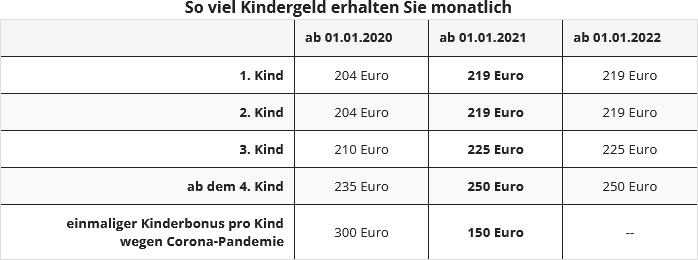
Child benefit is paid for children up to the age of 18. The child's income is irrelevant.
The entitlement continues for children over 18 until their 25th birthday, as long as they are in education or doing voluntary service. Child benefit is paid by the family offices of the Federal Employment Agency. Public sector employees or pension recipients receive the money from their employers.
Tipp
A child for whom you do not receive child benefit yourself can be counted as a so-called Zählkind to increase the child benefit entitlement for your other children. For example: A couple has three children together, and the husband also has a child from a previous relationship. The child lives with their biological mother, who also receives child benefit.
If the second wife now names her husband as the beneficiary, his first child can be counted as a Zählkind. The couple will not receive child benefit for this child, but the other children will be counted as the second, third, and fourth child. Over the year, the family receives 372 Euro more in child benefit.
Note: The Federal Fiscal Court has ruled on so-called Zählkinder in the context of non-marital partnerships as follows: If the parents of a joint child live together in a non-marital partnership and two older children from another relationship of one parent are also living in their household, the other parent does not receive the increased child benefit amount for a third child according to § 66 (1) EStG for the joint child (BFH ruling of 25.4.2018, III R 24/17).
(2021): Do I receive the same amount of child benefit for all children?
Who is entitled to child benefit and tax allowances?
Das Kindergeld ist einkommensunabhängig und wird gezahlt, wenn ein Anspruch darauf besteht. Eine Voraussetzung ist das Alter des Kindes, die andere das so genannte Kindschaftsverhältnis.
Ein Kindschaftsverhältnis ist grundsätzlich bei Kindern gegeben, die ersten Grades mit Ihnen verwandt sind. Das sind zunächst Ihre leiblichen Kinder, egal ob ehelich oder unehelich. Aber auch adoptierte Kinder sind im ersten Grad mit Ihnen verwandt. Auch bei einem Pflegekind besteht ein Kindschaftsverhältnis, wenn es bei Ihnen im Haushalt lebt und Sie zu ihm ein dauerhaftes Aufsichts-, Betreuungs- und Erziehungsverhältnis haben. Das Obhuts- und Pflegeverhältnis zu den leiblichen Eltern darf nicht mehr bestehen. Gelegentliche Besuche der leiblichen Eltern sind unschädlich.
Kindergeld wird auch gezahlt, wenn Sie in Ihrem Haushalt ein Stief- oder Enkelkind aufgenommen haben. In diesen Fällen liegt allerdings kein Kindschaftsverhältnis im Sinne des Steuerrechts vor. Deswegen steht Stief- oder Großeltern ein Kinderfreibetrag auch nicht automatisch zu, sondern nur dann, wenn die leiblichen Eltern die Freibeträge für Kinder auf die neuen Bezugspersonen übertragen.
Diese können dann auch von den sonstigen steuerlichen Vergünstigungen, etwa dem Ausbildungsfreibetrag, profitieren. Das kann sinnvoll sein, wenn die leiblichen Eltern selbst kaum Steuern zahlen, etwa weil sie noch studieren.
Bis zum 18. Geburtstag des Kindes muss für den Anspruch auf Kindergeld und Freibeträge keine weitere Voraussetzung erfüllt sein als die des bestehenden Kindschaftsverhältnisses. Ab dem 18. Geburtstag gibt es Kindergeld nur noch für Kinder, die in Ausbildung sind oder einen Freiwilligendienst leisten.
(2021): Who is entitled to child benefit and tax allowances?
What is the child allowance?
Kindergeld und Kinderfreibetrag sind eine Steuerentlastung für die Ausgaben, die den Eltern durch die Kinder entstehen. Der Anspruch auf Kindergeld besteht von Geburt an automatisch, muss aber schriftlich beantragt werden. Es sind nicht - wie oftmals angenommen - die Kinder, die Anspruch auf das Kindergeld haben, sondern die Eltern bzw. Erziehungsberechtigten, die für das Wohl des Kindes verantwortlich sind.
Kindergeld
Das Kindergeld ist ein monatlich ausgezahlter Betrag, den Eltern meist von der Familienkasse überwiesen bekommen. Das Kindergeld muss nicht versteuert werden. Die Höhe des Kindergeldes richtet sich nach der Anzahl der Kinder.

Kinderfreibetrag
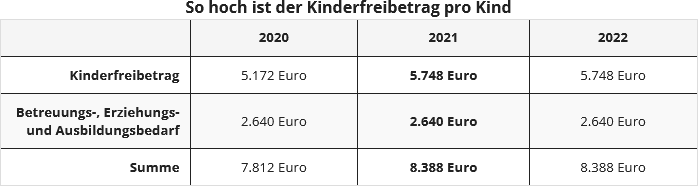
Der Kinderfreibetrag wird im Gegensatz zum Kindergeld nicht ausgezahlt. Der Freibetrag wird vom zu versteuernden Einkommen abgezogen. Dadurch wirkt er sich steuermindernd bei der Berechnung der Einkommensteuer aus. Das monatlich bereits ausgezahlte Kindergeld stellt eine Vorauszahlung auf den Kinderfreibetrag dar. Im Jahre 2021 beträgt der Kinderfreibetrag 5.460 Euro für zusammen veranlagte Eltern, ansonsten 2.730 Euro je Elternteil. Der BEA-Freibetrag (für Betreuungs-, Erziehungs- und Ausbildungsbedarf) beträgt 2.928 Euro.
Kindergeld und Kinderfreibetrag sind miteinander gekoppelt. Ob das Kindergeld oder der Kinderfreibetrag am Ende eines Steuerjahres für den Steuerpflichtigen günstiger ist, ermittelt das Finanzamt automatisch durch eine Günstigerprüfung.
Anspruch auf Kinderfreibetrag bzw. Kindergeld
Anspruch auf den Kinderfreibetrag haben die Erziehungsberechtigten von der Geburt des Kindes bis zum
- 18. Lebensjahr.
- 25. Lebensjahr, wenn sich das Kind noch in Ausbildung oder Studium befindet oder einen Freiwilligendienst leistet.
Wenn das Kind behindert ist und außerstande, sich selbst zu unterhalten, besteht der Anspruch auf Kindergeld oder Kinderfreibetrag zeitlich unbegrenzt.
(2021): What is the child allowance?
What impact does my child's stay abroad have on the child allowance?
Der Kinderfreibetrag und auch der BEA-Freibetrag (Freibetrag für den Betreuungs-, Erziehungs- oder Ausbildungsbedarf) sind beide unabhängig vom Wohnsitz Ihres Kindes. Jedoch müssen Sie als Elternteil in Deutschland uneingeschränkt einkommensteuerpflichtig sein.
Der Wohnsitz des Kindes ist aber für die Höhe des Kinderfreibetrages maßgeblich, denn je nach Land verringert sich der Freibetrag um ein, zwei oder drei Viertel. Um die Lebenshaltungskosten vor Ort einzustufen, gibt das Bundesfinanzministerium eine Ländergruppeneinteilung heraus.
Die Ländergruppeneinteilung ist immer dann relevant, wenn sich die Kinder im Ausland aufhalten und hat Auswirkungen auf
- den Kinderfreibetrag,
- den BEA-Freibetrags (für Betreuung, Erziehung und Ausbildung),
- die Höhe des Ausbildungsfreibetrags,
- die Berechnung der Kinderbetreuungskosten.
Kurzfristige Auslandsaufenthalte, wie Urlaubsreisen, führen nicht zu einer Kürzung. Das gilt auch bei vorübergehenden Aufenthalten wie beispielsweise bei einer Berufsausbildung.
(2021): What impact does my child's stay abroad have on the child allowance?
Which costs cannot be deducted as school fees?
Not all costs can be claimed for tax purposes. For example, if your child attends a boarding school, the expenses for accommodation, care and meals for your child must be deducted. School clothing and travel to school are also not tax-deductible as school fees.
The same applies to learning materials, as well as school books or computers that you purchase yourself. Costs for additional courses or school trips cannot be included in the tax return either.
Finally, costs for individual private tuition, music schools, sports clubs, holiday courses and tutoring are not deductible.
(2021): Which costs cannot be deducted as school fees?