What is a statutory annuity?
Annuities are fixed payments linked to a person's lifetime. Annuities and other benefits from statutory pension insurance, the agricultural pension fund, and professional pension schemes are only partially taxable, depending on the year the pension started.
If you have received a pension from statutory pension insurance, you can request a “Statement for submission to the tax office” regarding your pension income as a filling aid. This will then be sent to you automatically in subsequent years. If the pension started in 2020, the taxable portion is 80%.
No entries regarding the taxable portion are required in the tax return. The tax-free part of the pension is determined in the year following the start of the pension and generally applies for the entire duration of the pension. In subsequent years, this amount is deducted from the annual (gross) pension amount.
Pension increases based on regular adjustments are fully taxable. The same applies to benefits from private basic pension contracts (so-called Rürup pensions).
Annuities include in particular
- old-age pensions,
- disability pensions,
- incapacity pensions,
- occupational disability pensions,
- survivor's pensions such as widow's/widower's pensions,
- orphan's pensions, or
- parental pensions.
One-off payments, such as death benefits or settlements of small pensions, must also be declared. If you have been recognised as a victim of National Socialist persecution under § 1 of the Federal Compensation Act (BEG) and pension periods due to persecution were taken into account in the calculation of your statutory pension, please inform the tax office informally.
Such periods may have been considered under the Act on the Payment of Pensions from Employment in a Ghetto (ZRBG), the Act on the Settlement of National Socialist Injustice in Social Insurance (WGSVG), or the Foreign Pensions Act (FRG). This also applies to widow's/widower's pensions if the deceased was recognised as a victim under § 1 BEG and the pension includes corresponding pension periods. The tax office will check whether this pension is tax-free.
(2021): What is a statutory annuity?
How is the statutory pension taxed?
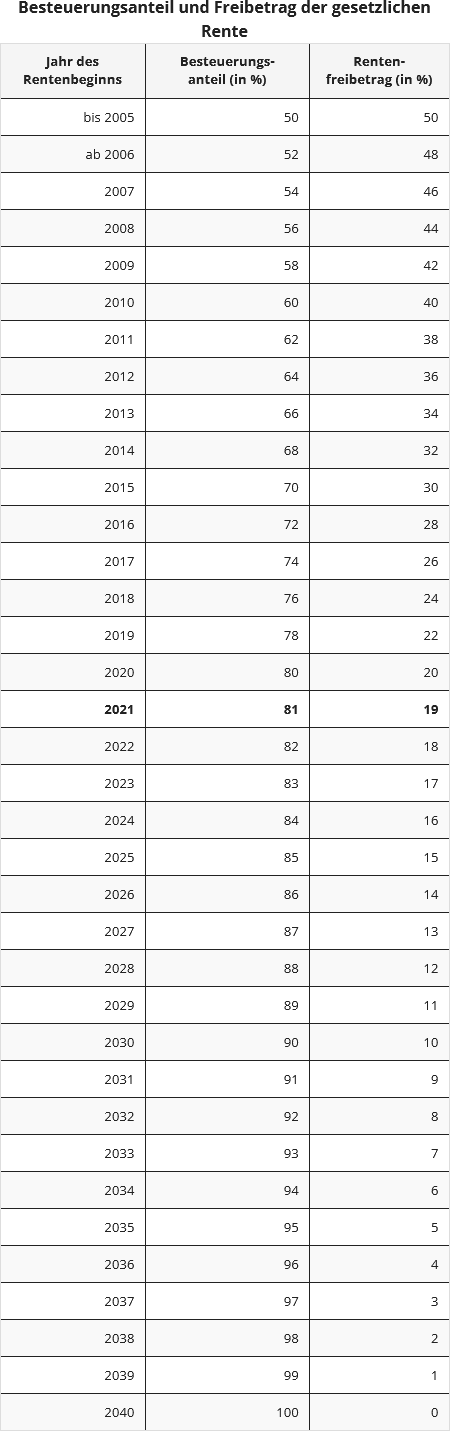
Der Gesetzgeber hat im Jahr 2005 die Besteuerung der gesetzlichen Rente durch das Alterseinkünftegesetz neu geregelt. Seitdem ist ein festgelegter Anteil der Rente zu versteuern, der Rest bleibt (noch) steuerfrei. Sie müssen Ihre Einnahmen aus der Rente versteuern, das ist die sogenannte nachgelagerte Besteuerung. Wie viel sie versteuern müssen, richtet sich nach dem Jahr Ihres Renteneintritts.
Für Personen, die im Jahre 2005 oder vorher in Rente gingen, lag der steuerfreie Anteil bei 50 Prozent. Aus der nicht zu versteuernden Rente wird ein (persönlicher) Freibetrag gebildet, sodass diese Rentner ab 2005 einen "Rentenfreibetrag" von 50 Prozent nutzen können. Dieser Rentenfreibetrag bleibt lebenslang unverändert.
Seit 2005 steigt der sog. Besteuerungsanteil jährlich um zwei Prozentpunkte, ab 2021 um einen Prozentpunkt pro Jahr. So müssen Personen, die ab 2040 in Rente gehen, ihre gesetzlichen Renteneinnahmen voll versteuern.
Das Finanzamt zieht automatisch auch ohne weiteren Nachweis einen Pauschbetrag für Werbungskosten von 102 Euro ab. Wenn Sie höhere Aufwendungen haben, sollten Sie diese in der Steuererklärung angeben, um Ihr zu versteuerndes Einkommen nach unten zu drücken. Angeben können Sie etwa Steuerberatungskosten (für die Anlage R), eine Rentenberatung oder einen Anwalt, wenn er Sie in Rentenfragen unterstützt. Die höheren Ausgaben müssen Sie allerdings in jedem Fall nachweisen.
Beispiel
Hans Müller ging zum 1. Januar 2009 in Rente und bekam im letzten Jahr eine gesetzliche Rente von insgesamt 12.000 Euro. Für Hans Müller sind 58 Prozent seiner Rente steuerpflichtig, der Rentenfreibetrag liegt bei 42 Prozent. So müsste Müller für das Jahr 6.960 Euro beim Finanzamt als Einnahmen angeben. Hat er aber keine weiteren Einnahmen, dann muss er auch keine Steuererklärung abgeben, denn die Summe liegt unter dem Grundfreibetrag von 9.744 Euro (2021).
Der lebenslange Rentenfreibetrag für Hans Müller beträgt 5.040 Euro. Einnahmen über diesem Freibetrag müsste er jedoch erst versteuern, wenn sie auch über dem Grundfreibetrag liegen.
Die Einnahmen aus Vermietung und Verpachtung oder Kapitalerträge müssen allerdings dem Einkommen zugerechnet werden.
Würde Hans Müller dagegen eine Rente von 15.000 Euro beziehen und erst 2021 in den Ruhestand gehen, dann müsste er 12.150 Euro (81 Prozent) von seiner Rente versteuern und demzufolge auch eine Steuererklärung abgeben.
Achtung: Bis zu seinem Lebensende bleibt der Rentenfreibetrag für Müller gleich. Auch wenn nach Rentenanpassungen seine Einnahmen durch die Rente steigen, blieben im ersten Beispiel jedes Jahr nur 5.040 Euro steuerfrei. Der Freibetrag bezieht sich auf einen konkreten Geldbetrag, nicht auf einen Anteil der jeweiligen Rente. So muss Herr Müller künftige Rentenanpassungen also voll versteuern.
(2021): How is the statutory pension taxed?
Which income-related expenses can I claim as a pensioner?
Even as a pensioner, you can claim expenses related to your pension as income-related expenses in your tax return. If your income-related expenses total less than 102 Euro, it is not worth entering them. The tax office automatically applies an income-related expenses allowance of 102 Euro, which is immediately deducted from your income. This allowance is applied jointly for all pensions and all income that must be declared under other income. It is an annual amount that is not reduced, even if the conditions did not apply for the entire year or if there was no income for the whole year. The income-related expenses allowance is personal and is available to each spouse separately as soon as they have the relevant income.
Tip: If you have higher expenses exceeding the allowance of 102 Euro, it is definitely worth entering them. However, you should also have the evidence ready and enclose it with your tax return. If you have expenses for a tax advisor, the tax office will only recognise the costs as income-related expenses if they are related to your pension. Therefore, ask your tax advisor to specify separately in their invoice the part that directly relates to your pension.
Income-related expenses you can claim include, for example, expenses for a
- pension advisor,
- lawyer in pension disputes,
- tax advisor (only for form R), and also
- costs related to applying for a pension (travel expenses, office supplies, postage, telephone costs)
- court fees if the case concerns your pension
- union fees you pay as a pensioner
- flat-rate account maintenance fee of 16 Euro per year
Tip
If you are unsure whether the tax office will recognise a particular expense, simply declare it and enclose the evidence. The tax officer will decide.
(2021): Which income-related expenses can I claim as a pensioner?
What does the 2005 Retirement Income Act regulate?
The Pension Income Act regulates the taxation of pensions. It affects everyone, both pensioners who were already retired in 2005 and all future retirees. The tax burden for new pensioners increases year by year - at the same time, the benefits for employees also grow.
Tax-advantaged pension provision
In addition to the statutory pension insurance, private pension insurance is also recognised as a pension provision (so-called basic pension or Rürup pension). Contributions to private pension insurance are only tax-advantaged if the insurance is aimed at a lifelong pension for the taxpayer. In addition, the insured person must be at least 60 years old when the pension payments begin. For contracts concluded from 2012 onwards, pension payments may not begin until the age of 62. This ensures that they are pension provision products. Furthermore, pension entitlements must not be transferable, pledgeable, sellable, or capitalisable. The insurance sum must also be paid out as an annuity; lump-sum payments are generally prohibited. However, tax-advantaged pension products can be supplemented with additional insurance - for example, occupational disability insurance.
Investment products that do not necessarily serve as pension provision are not tax-advantaged. These are usually freely available capital investments, which also include endowment life insurance. An exception is endowment life insurance policies concluded before 2005. They remain tax-free.
For pensioners, this means the following:
Since 2005, 50 per cent of pension income has been taxable. From 2006 to 2020, the taxable portion of pensions increases by two percentage points annually, and from 2021, the portion increases by only one percentage point per year. In 2040, the pension will be 100 per cent taxable, whereas employee contributions to pension provision will then be largely tax-free.
Also regulated in the Pension Income Act: Temporary pensions, such as disability pensions, and non-temporary pensions, such as old-age pensions, have been treated equally for tax purposes since 2005. Pensions from insurance policies that are tax-advantaged during the accumulation phase are taxable during the payout phase.
Note:
At the end of May 2021, the Federal Fiscal Court published its two rulings on the possible double taxation of pensions. However, the lawsuits filed by the affected pensioners were unsuccessful. The Federal Fiscal Court considers double taxation to be possible only in a few individual cases. It considers the basic system of pension taxation to be lawful, i.e. the limited deduction of pension expenses during working life, combined with the partial tax exemption of pensions during the payout phase. Double taxation is only likely to occur for later generations of pensioners (Federal Fiscal Court rulings of 19.5.2021, X R 33/19 and X R 20/21). However, the unsuccessful plaintiffs have lodged a constitutional complaint against the two decisions of the Federal Fiscal Court (Ref. 2 BvR 1143/21 and 2 BvR 1140/21).
The issue is how double taxation is calculated in detail. The Federal Fiscal Court has taken a very schematic view, which only leads to excessive taxation of pensions in individual cases. For the calculation of possible double taxation, the nominal value principle applies. In simple terms, the actual contributions paid and subsidised pension expenses are to be compared with the actual pension payments received, which are partially exempt. Neither amounts are to be discounted or compounded, nor is inflation to be taken into account.
However, some experts, as well as the plaintiffs in case X R 33/19, argued that during the working phase, no pension amounts are acquired in cash, but rather pure pension points. The actual amount of the pension only becomes clear much later. However, the Federal Fiscal Court did not delve into the "depths" of financial and insurance mathematics but compared contributions paid with payments received. Whether this is correct or whether there is a more favourable calculation for taxpayers is to be clarified by the constitutional judges in Karlsruhe.
The federal and state governments have now finally agreed to issue affected tax assessments on a provisional basis regarding the disputed point. Specifically, tax assessments are issued provisionally with regard to the "taxation of annuities and other benefits from basic provision under section 22 number 1 sentence 3 letter a double letter aa EStG". The provisional note is attached to all income tax assessments for assessment periods from 2005 onwards in which an annuity or other benefit from the so-called basic provision is recorded (BMF letter of 30.8.2021, V A 3 - S 0338/19/10006 :001).
This means that pensioners will now receive income tax assessments with a note on the - partial - provisional nature of the tax assessment. If the Federal Constitutional Court finds that the current taxation of statutory pensions and pensions from occupational pension schemes and similar pension schemes is unconstitutionally high, the tax assessments issued now and in the future can be amended without a prior objection.
(2021): What does the 2005 Retirement Income Act regulate?
What does the opening clause mean?
Bei der nachgelagerten Besteuerung kann es zu einer ungerechten Übersteuerung kommen, wenn ein Selbständiger über mehrere Jahre Beiträge an ein berufsständisches Versorgungswerk gezahlt hat, die höher waren als der Jahreshöchstbeitrag in der gesetzlichen Rentenversicherung (Summe des Arbeitgeberanteils und des Arbeitnehmeranteils). Der zu zahlende Höchstbetrag richtet sich nach der Beitragsbemessungsgrenze.
Diese wird jährlich neu berechnet und stellt die Grenze dar, bis zu der die Rentenversicherungsbeiträge anteilig vom Einkommen gezahlt werden müssen. Für Einkommen, das über der Beitragsbemessungsgrenze liegt, leisten Sie normalerweise keine Versicherungsbeiträge – außer Sie zahlen sie wie in diesem Zusammenhang freiwillig.
Der Selbständige hat also aus seinem bereits versteuerten Einkommen freiwillig zusätzliche Beiträge gezahlt. Dadurch hat er sich auf der einen Seite eine höhere Rente erarbeitet, die er aber auf der anderen Seite mit dem üblichen Besteuerungsanteil zu hoch besteuern müsste. Das kann vermieden werden. Als Rentner kann er seine Rente in einen freiwilligen und in einen gesetzlichen Teil aufteilen lassen. Hierzu muss er aber bis zum 31.12.2004 mindestens zehn Jahre lang freiwillig einen höheren Beitrag gezahlt haben.
Tipp
Wenn dies auf Sie zutrifft, müssen Sie beantragen, dass der Anteil Ihrer Rente, der auf diesen erhöhten Beiträgen beruht, nicht mit dem hohen Besteuerungsanteil (2021: 81 Prozent der Rente), sondern mit dem wesentlich günstigeren Ertragsanteil besteuert wird. Der Anteil der niedriger zu besteuernden Rente ist die Öffnungsklausel, diese erfahren Sie aus der Bescheinigung Ihres Rentenversicherungsträgers.
Beispiel
Wenn Sie seit Ihrem 65. Lebensjahr eine gesetzliche Rente von 1.500 Euro im Monat beziehen und dem Finanzamt mit einer Bescheinigung der Rentenzahlstelle nachweisen können, dass 30 Prozent (das ist die Öffnungsklausel) der Rentenzahlung auf erhöhten Beiträgen beruhen, ergibt sich diese Berechnung:
Für 70 Prozent der Rente: Normale Besteuerung nach Abzug des Rentenfreibetrags: 1.500 Euro x 70 Prozent = 1.050 Euro x 12 Monate = 12.600 Euro abzgl. Rentenfreibetrag von (zum Beispiel) 42 Prozent = 7.308 Euro.
Bei dem Teil, für den die Öffnungsklausel von 30 Prozent gilt, wird der günstigere Ertragsanteil angesetzt: 1.500 Euro x 30 Prozent = 450 Euro x 12 Monate = 5.400 Euro x 18 Prozent = 972 Euro. In diesem Fall müssten also 8.280 Euro versteuert werden. Ohne Öffnungsklausel hätten 10.440 Euro versteuert werden müssen.
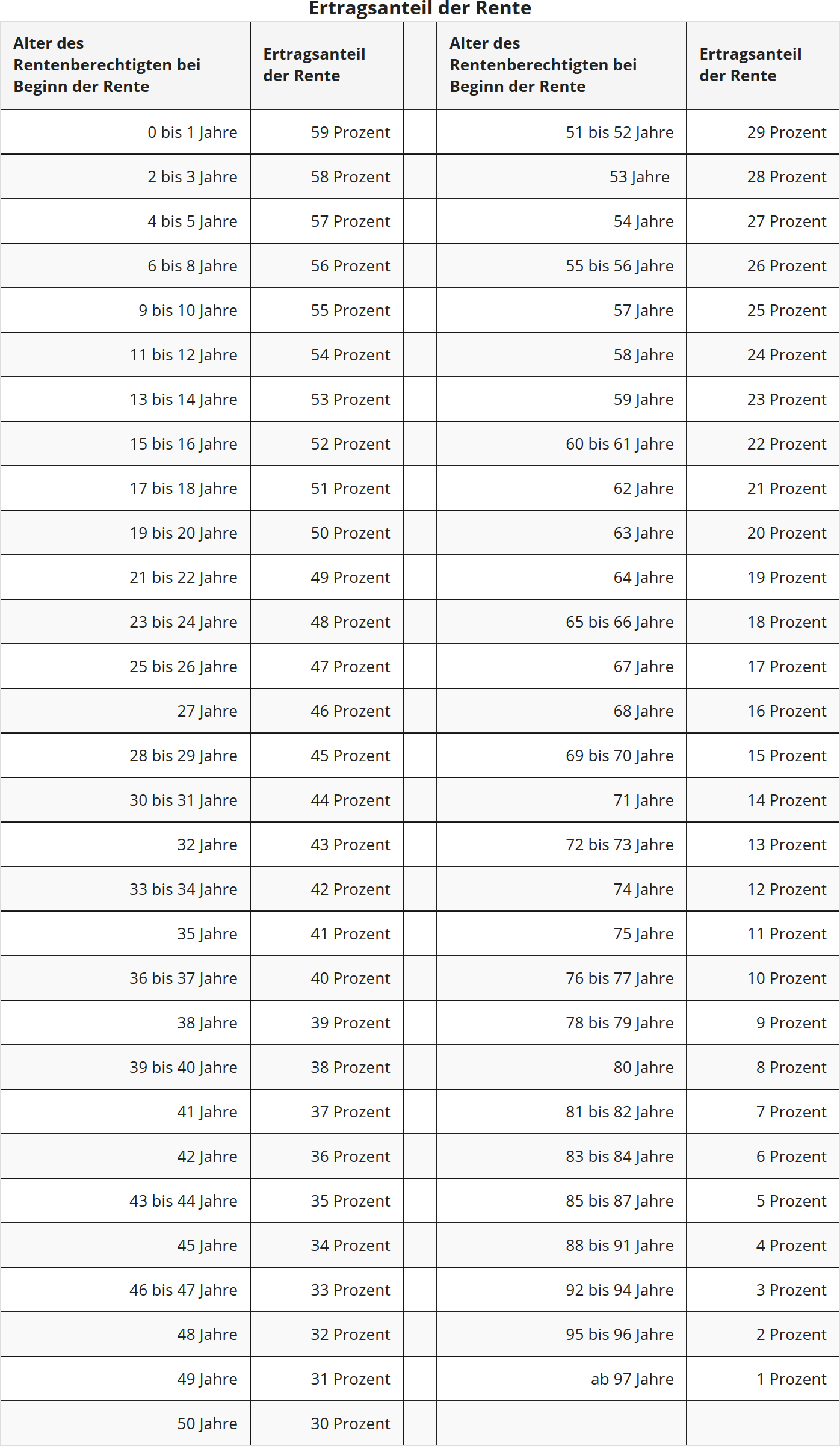
Der Ertragsanteil richtet sich nach dem Alter des Rentners zum Beginn der Rentenzahlung, er beträgt beispielsweise bei 64-Jährigen 19 Prozent, bei 65- bis 66-Jährigen 18 Prozent und bei 67-Jährigen 17 Prozent.
In der folgenden Tabelle finden Sie die Höhe des Ertragsanteils je nach Alter bei Beginn der Rente; dieser wird von Lohnsteuer kompakt automatisch berechnet:
Hinweis:
Ende Mai 2021 hat der Bundesfinanzhof seine beiden Urteile zur möglichen Doppelbesteuerung von Renten veröffentlicht. Die Klagen der betroffenen Rentner blieben allerdings erfolgslos. Der BFH hält eine Doppelbesteuerung nur in wenigen Einzelfällen für möglich. Die grundsätzliche Systematik der Rentenbesteuerung hält er für rechtens, also den begrenzten Abzug der Altersvorsorgeaufwendungen im Erwerbsleben, verbunden mit der nur teilweisen Steuerbefreiung der Renten in der Auszahlungsphase. Eine doppelte Besteuerung zeichne sich erst für spätere Rentnerjahrgänge ab (BFH-Urteile vom 19.5.2021, X R 33/19 und X R 20/21). Allerdings haben die unterlegenen Kläger gegen die beiden Entscheidungen des BFH Verfassungsbeschwerde eingelegt (Az. 2 BvR 1143/21 und 2 BvR 1140/21).
Es geht um die Frage, wie eine Doppelbesteuerung konkret berechnet wird. Der BFH hat eine sehr schematische Sichtweise eingenommen, die nur im Einzelfall zu einer zu hohen Besteuerung von Renten führt. So gelte für die Berechnung einer möglichen Doppelbesteuerung das Nominalwertprinzip. Es seien - etwas vereinfacht gesprochen - die tatsächlich eingezahlten und begünstigen Vorsorgeaufwendungen - mit den später tatsächlich gezahlten und teilweise befreiten Rentenbeträgen zu vergleichen. Weder seien Beträge auf- oder abzinsen noch sei eine Inflation zu berücksichtigen.
Von einigen Experten, aber auch von den Klägern im Verfahren X R 33/19, wurde hingegen die Auffassung vertreten, in der Erwerbsphase werden keine Rentenbeträge in Geld, sondern reine Entgeltpunkte erworben. Die tatsächliche Höhe der Rente kristallisiere sich erst viel später heraus. Doch der BFH hat sich nicht in die "Niederungen" der Finanz- und Versicherungsmathematik begeben, sondern vergleicht eingezahlte mit ausgezahlten Geldbeträgen. Ob das richtig ist oder ob es eine für Steuerzahler günstigere Rechnung gibt, sollen die Verfassungshüter in Karlsruhe klären.
Aktuell haben sich Bund und Länder endlich dazu durchringen können, betroffene Steuerbescheide hinsichtlich des streitigen Punktes vorläufig ergehen zu lassen. Konkret: Steuerfestsetzungen ergehen vorläufig hinsichtlich der "Besteuerung von Leibrenten und anderen Leistungen aus der Basisversorgung nach § 22 Nummer 1 Satz 3 Buchstabe a Doppelbuchstabe aa EStG". Der Vorläufigkeitsvermerk wird sämtlichen Einkommensteuerbescheiden für Veranlagungszeiträume ab 2005 beigefügt, in denen eine Leibrente oder eine andere Leistung aus der sogenannten Basisversorgung erfasst wird (BMF-Schreiben vom 30.8.2021, V A 3 - S 0338/19/10006 :001).
Das heißt: Rentner erhalten von nun an Einkommensteuerbescheide mit einem Hinweis auf die - teilweise - Vorläufigkeit der Steuerfestsetzung. Sollte das Bundesverfassungsgericht der Auffassung sein, dass die derzeitige Besteuerung von gesetzlichen Renten und Renten aus berufsständischen Versorgungswerken sowie ähnlichen Altersversorgungen verfassungswidrig zu hoch ist, so können die Steuerbescheide, die jetzt und in Zukunft ergehen, auch ohne vorherigen Einspruch geändert werden.
(2021): What does the opening clause mean?