Software Hosted in Germany Hosted in Germany
Secure. Fast. Reliable.  
Digital data transmission - in accordance with sect. 87c of the German Fiscal Code
Digital data transmission


The entire world of tax knowledge

Lohnsteuer kompakt FAQs


AI power for your tax:

With IntelliScan KI beta
for effortless refund!

No more tax stress!
Learn how to use IntelliScan to complete your tax return faster and more efficiently. Simply upload your documents – our AI recognises and processes all the important information for you.

Wages


What is tax-free wages under DBA/ATE?

This refers to tax-free wages under a double taxation agreement (DTA) or foreign employment decree (FED). A DTA stipulates how employees working abroad must tax their income to avoid double taxation. Wages for work abroad can be tax-free under the foreign employment decree if there is no double taxation agreement with the relevant country and the work lasts for at least three consecutive months. Illness or holiday does not affect the duration of employment but is not counted towards the three-month period.

If your salary is taxable abroad, you will be exempt from tax in Germany under a DTA or FED. However, income taxed abroad is included in the progression clause in Germany. This means that a total income is calculated from the foreign income and other income in Germany. This total income results in a higher tax rate, but only the income earned in Germany is taxed at this rate.

Exceptions:

  • For France, Austria, and Switzerland, a special cross-border commuter regulation applies under the double taxation agreement. If you work in these countries, the wages are taxed in the country of residence, Germany.
  • In Switzerland, the employer may deduct a wage tax of 4.5 percent, which is credited against the tax in Germany.
  • Civil servants and public sector employees always tax their income in the country where they work, as the principle of the paying state applies.

Note: The foreign employment decree has recently been revised. We would like to draw your attention to a particularly important new provision: employees must prove that their wages abroad were subject to a minimum taxation. If you cannot provide proof or if there is no minimum taxation, the foreign employment decree and thus the tax exemption in Germany do not apply. The new regulations apply to wages and other remuneration paid after 31.12.2022 or received by the employee after this date.

Note: More and more double taxation agreements are currently being amended to give special consideration to home office days. In individual cases, it should therefore be carefully checked where the right of taxation lies.

What is tax-free wages under DBA/ATE?


When and how must I declare income as a cross-border commuter?

The cross-border commuter tax return raises questions for many employees: If you live in Germany but regularly work in a neighbouring country, you are not automatically correctly classified for tax purposes. The special regulations of the double taxation agreements are decisive. The following article explains clearly when income as a cross-border commuter must be declared, which forms are required for the tax return, and when the progression clause applies.

Who is considered a cross-border commuter for tax purposes?

Cross-border commuters are employees who have their residence in Germany and regularly commute to work in a neighbouring country, such as France, Austria, or Switzerland. The relevant double taxation agreements and the actual return to the German residence are decisive.

Important: Cross-border commuter status does not arise automatically, but only if the conditions are met.

Where is the salary taxed?

As a rule, salary is taxed where the work is performed. However, for cross-border commuters, the relevant double taxation agreement often provides for an exception:

The salary is taxed in Germany, even though the work is carried out abroad.

  • The entire salary is subject to German income tax.
  • In the foreign country, there is usually no or only limited withholding tax.
  • There is no progression clause because the salary is not tax-free but is taxed regularly in Germany.
Cross-border commuter tax return: Where do I enter the salary?

If you are a cross-border commuter in the tax sense, the entry is as follows:

  • Form N for regular salary
  • additional Form N-GRE, only if you live in Baden-Württemberg and work in France, Austria, or Switzerland

Important: You must not use Form N-AUS in this case. The cross-border commuter regulation and Form N-AUS are mutually exclusive.

Cross-border commuter or not – the distinction

You are considered a cross-border commuter if:

  • You regularly return to your residence in Germany.
  • You comply with the permitted number of non-return days (e.g. Switzerland: maximum 60 days).
  • Your salary is taxed in Germany.

Consequence: Entry in Form N (and possibly Form N-GRE), no progression clause.

You are not considered a cross-border commuter if:

  • You do not return to your German residence often enough.
  • You mainly live or work abroad.
  • You have other foreign income that does not fall under the cross-border commuter regulation.

In this case, the following usually applies: Taxation in the country of work. The salary is often tax-free in Germany but increases the tax rate for other income through the progression clause according to § 32b EStG.

=> Entry: Form N-AUS.

Special features depending on the country
  • France and Austria: Cross-border commuters generally tax their salary in Germany.
  • Switzerland: The employer may withhold 4.5 percent withholding tax. This is usually credited against German income tax.
Special case: Civil servants and public service

For civil servants and public service employees, a special rule applies: Income is generally taxed in the employer's country, even if the other conditions of a cross-border commuter situation are met.

Conclusion

The cross-border commuter tax return depends crucially on where the salary is assigned for tax purposes. Those who meet the cross-border commuter regulation declare their income as domestic salary and avoid the progression clause. If the conditions are not met, Form N-AUS is required. A clear distinction reduces queries from the tax office and prevents unnecessary tax disadvantages.

Elektronischen Steuererklärung ohne Anlage N-GRE

In practice, it may happen that Form N-GRE is not separately supported in some electronic tax programs, for example when using Lohnsteuer kompakt. In these cases, this does not automatically mean that the cross-border commuter information is lost.

If your salary is fully taxable in Germany, it will still be correctly declared in Form N. The additional information relevant for cross-border commuters (e.g. about the foreign employer or cross-border commuter status) should then be added in the designated free text or explanation field of the tax return.

It is also advisable to include a short written explanation stating that the conditions of the cross-border commuter regulation are met. This makes it easier for the tax office to classify and reduces queries.

Important: Even if Form N-GRE cannot be selected technically, the material tax obligation remains unchanged. It is crucial that the salary is correctly declared as taxable in Germany.

When and how must I declare income as a cross-border commuter?


Field help

+ Gross wages (line 3 of the employment tax statement).

The amount (gross wage according to line 3 of the employment tax statement) is based on all the employment tax statements you received in the year 2025.

Have you received tax-free wages in special cases?

Answer "yes" if you have received wages abroad that are tax-free in Germany under a double taxation agreement (DTA).

Typical cases:

  • Employment at a foreign public institution (e.g. school, government agency, university),
  • Taxation of wages abroad or payment by a foreign state treasury,
  • Tax exemption according to a double taxation agreement (DTA).
+ Gross tax-free wages (line 16 of the employment tax statement)

The amount (tax-free wages according to the double taxation agreement (DBA) or the decree on employment abroad (ATE), according to line 16 of the employment tax statement) is based on all the employment tax statements that you received in the year 2025.

+ Gross wages without tax deduction in Germany

Enter here the total wages from which no German wage tax was deducted.

The wages from a foreign employer that are not shown on the employment tax statement should be entered here.

Important: Make sure that you do not enter any amounts here that are already included in your German employment tax statement.

= Subtotal

The sum of the specified gross wages.

Example to clarify: Assume you work in both Germany and France. Your gross salary from Germany is 50.000 Euro and is shown in line 3 of your employment tax statement. In addition, you have tax-free gross wages of 5.000 Euro, which is shown in line 16 of your employment tax statement. You have received 30.000 Euro from your French employer, for which no German wage tax was withheld.

Your subtotal is then: 50.000 Euro (gross salary Germany) + 5.000 Euro (tax-free Germany) + 30.000 Euro (gross salary France) = 85.000 Euro

Designation of the tax-free wages

Enter here salary components that are included in your gross salary and are taxable abroad but tax-free in Germany. This includes:

Tax-free travel expense allowances or supplements: These may be exempt from tax under German law and must therefore be deducted from your gross salary.

Expatriation allowances: Special allowances for international assignments that are taxable abroad but tax-free in Germany.

Expatriate allowances: Allowances to cover the additional costs of living abroad, which are taxable abroad but tax-free in Germany.

Housing cost allowances: Allowances to cover your housing costs abroad that are taxable abroad but tax-free under German law.

School fee reimbursements: Reimbursements for your children's school fees abroad that are taxable abroad but tax-free in Germany.

Training and further education costs: Costs for further professional training abroad that are taxable abroad but exempt from tax in Germany.

These salary components must be deducted from your gross salary as they do not reduce your taxable income in Germany.


Note: Tax-free wages under a double taxation agreement (DTA) or foreign activity decree (ATE) do not need to be entered here.

Designation of taxable wages

If your gross salary includes salary components that are tax-free under foreign law but taxable under German law, enter them here. Examples of this are:

Bonus payments: Tax-free abroad, but taxable in Germany.

Success shares: Tax-free abroad, but taxable in Germany.

Compensation for overtime: Tax-free abroad, but taxable in Germany.

Company car: Tax-free use abroad, but taxable in Germany.

Also include amounts that are in addition to your salary and are taxable under German law. These may be additional remuneration or benefits that are not already included in your gross salary.

Note: Taxable wages according to double taxation agreements (DTA) or foreign activity decree (ATE) are not to be stated here.

= Total domestic and foreign wages

The total amount of domestic and foreign wages is calculated after the tax-free amounts have been deducted and the taxable amounts have been added.

Example to illustrate: Your gross salary (domestic and foreign) is 85.000 Euro. Of your foreign salary, 5.000 Euro are tax-free. In addition, you have 3.000 Euro which are taxable under German law.

The total amount of domestic and foreign wages included in the tax calculation is 83.000 Euro.

Designation

Enter here only salary components that were granted directly on the basis of specific work performed in Germany. Examples of this are:

Travel expenses: Reimbursements for business-related travel within Germany.

Overtime compensation: Payments for overtime worked.

Pay for work on Sundays, public holidays and at night: Extra pay for work at unusual times.

Expatriation allowances: Additional benefits for assignments abroad that relate to domestic activities.

Project-related performance bonuses: Bonuses for successfully completed projects in Germany.

As a rule, the employer has already allocated the expenses in the payslip and shown the tax-free wages on the wage tax statement. The tax office can review the allocation as part of the tax return.

Designation

Only enter salary components (special remuneration) here that were granted directly as a result of specific work performed abroad. This includes, among other things:

Travel expenses: Reimbursements for business-related travel abroad.

Overtime compensation: Payments for overtime worked while working abroad.

Surcharges for work on Sundays, public holidays and at night: Extra remuneration for work at unusual times abroad.

Expatriation allowances: Additional benefits for assignments abroad.

Project-related performance bonuses: Bonuses for successfully completed projects abroad.

Provision of accommodation in the host country: Costs for the provision of accommodation abroad.

Language teaching expenses: Costs for language courses that are necessary to carry out the work abroad.

Expenses for visas: Costs for visas required to work abroad.

Expenses for medical examinations: Expenses for health checks in connection with work abroad.

Other support benefits for accompanying family: Financial support or reimbursements for dependents travelling abroad.

As a rule, the employer has already allocated the expenses in the payslip and shown the tax-free wages in the employment tax statement. The tax office can review the allocation as part of the tax return.

= Remaining wages

The remaining salary is divided according to the proportion of the agreed working days abroad to the other agreed working days

Did you receive any other special wage components?

If you have received other special wage components, please select "yes". Special wage components include, for example:

  • indemnities,
  • severance payments,
  • payments for several years of work or
  • stock option programmes.

Corresponding entries must be made for tax-free wage components that fall under the one-fifth rule in accordance with sect. 34 of the Income Tax Act (EStG).

Further information on tax treatment can be found in the letter from the Federal Ministry of Finance dated 03.05.2018 (IV B 2 - S 1300/08/10027, BStBl 2018 I p. 643) on the tax treatment of wages in accordance with double taxation agreements.

Designation

Enter the wages which are assignable to other countries.

On which other intergovernmental agreement is the work based?

Specify the intergovernmental agreement on which your tax exemption is based. This may be a specific agreement between Germany and another country or an international agreement that provides for special tax regulations for your activity.

For which organisation is the work carried out (exact name)?

Enter the name and exact description of the organisation where you are employed, for example:

  • European Union (EU)
  • United Nations (UN)
  • World Health Organisation (WHO)
  • NATO (North Atlantic Treaty Organisation)
  • International Atomic Energy Agency (IAEA)
  • International Organisation for Migration (IOM)
  • European Bank for Reconstruction and Development (EBRD)
  • International Monetary Fund (IMF)
  • World Bank
  • Organisation for Economic Cooperation and Development (OECD)
Type of work performed

Describe the nature of your activity under the intergovernmental agreement. This is important in order to correctly categorise the tax exemption or regulation.

Specify whether you are an employee of the international organisation or work as an independent expert for this organisation. If available, please attach relevant documentation to verify your activity.

Amount of wages with progression clause applied

Enter the tax-free wages that you have received as part of your employment. This amount is subject to the progression clause, which means that it is taken into account when calculating the tax rate for your other income. Even if the wages are tax-free, they will be used to calculate the tax rate for your taxable income in Germany.


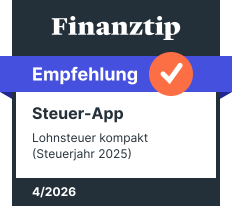
Finanztip

"Die Programme überzeugten mit einem großen Leistungsumfang, einer exakten Berechnung und allen Zusatzfunktionen."

Finanztip 10/2025

Macwelt

"Künstliche Intelligenz hat nun auch Einzug in das Programm erhalten. […] Mit IntelliScan werden Daten aus hochgeladenen Belegen analysiert und an der passenden Stelle in der Steuererklärung eingefügt."

Macwelt 03/2025

WirtschaftsWoche

"Lohnsteuer Kompakt bietet eine aufgeräumte Oberfläche und strukturierte Abfrage. [...] Pluspunkt sind abschließende Tipps zum Steuersparen, die auf den konkreten Fall angepasst sind."

WirtschaftsWoche 04/2024

Focus
Computer Bild
Börse online
Focus Money
€uro am Sonntag
€uro
c't Magazin
Chip
Die Welt am Sonntag
Stern
Handelsblatt
netzwelt